


 pair to
an egress point
pair to
an egress point
 in a way that minimizes the objective
function
in a way that minimizes the objective
function  . A solution can be realized by setting
 to a low value, while setting
 to a
high value for all
to a
high value for all
 , and all
  values to zero. In
contrast to the fixed-ranking scheme in Section II-B, we
allow a router's ranking of egress points to differ across the
prefixes. In practice, we envision solving richer optimization
problems that consider robustness to changes in the network topology
values to zero. In
contrast to the fixed-ranking scheme in Section II-B, we
allow a router's ranking of egress points to differ across the
prefixes. In practice, we envision solving richer optimization
problems that consider robustness to changes in the network topology
 , the egress sets
  , and the traffic demands
  , which
would lead to solutions that assign values to both and
, which
would lead to solutions that assign values to both and
 . In this paper, we focus on fixed topology, egress sets, and
traffic demands, to illustrate how TIE provides the flexibility needed
to balance load across the links.
. In this paper, we focus on fixed topology, egress sets, and
traffic demands, to illustrate how TIE provides the flexibility needed
to balance load across the links.
We formulate the egress-selection problem as a path-based
multicommodity-flow problem that accounts for the constraints that the
routing matrix
 imposes on the flow of traffic. For a
router
imposes on the flow of traffic. For a
router  and prefix
  , we consider the topology
 induced
by the links
induced
by the links
 for which
 . All links in
the graph
can be used to route traffic
from to through the egress point
. All links in
the graph
can be used to route traffic
from to through the egress point  . We call
  a
path in the multicommodity-flow formulation. We represent the actual
routing of the traffic from to by a
a
path in the multicommodity-flow formulation. We represent the actual
routing of the traffic from to by a  -decision variable
 , such that
 if and only if the path
is selected to send traffic from to . The choice of
a path determines the egress point
selected. For all
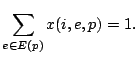
pairs , the egress-selection problem requires that a single
egress point
be chosen. We express this requirement by
the following equation:
if and only if the path
is selected to send traffic from to . The choice of
a path determines the egress point
selected. For all
pairs , the egress-selection problem requires that a single
egress point
be chosen. We express this requirement by
the following equation:
The contribution of the traffic going from to to the load on
link  is the product of the traffic demand , the
routing-matrix element
, and the decision variable
. The total load on a link is the sum of all the
contributions, i.e.
is the product of the traffic demand , the
routing-matrix element
, and the decision variable
. The total load on a link is the sum of all the
contributions, i.e.

A piecewise-linear integer-programming formulation for the
single egress-selection problem is to minimize the objective function
 such that the -decision
variables sum to
such that the -decision
variables sum to  for each pair. Defining
 to be a linear variable and applying a standard
transformation results in the linear integer-programming
formulation:
to be a linear variable and applying a standard
transformation results in the linear integer-programming
formulation:
 |
 |
|
| s.t. | ||
 |
||
 |
||
 |
||
 |
||
 |
||
 |
||
 |
||
 |
||
 |
||
 |
However, in general, this integer multicommodity-flow problem is
intractable. Instead, we consider its linear-programming relaxation
obtained by relaxing the integrality constraints
 to simply
 . For both networks we consider,
the CPLEX solver produced solutions with only integer values of
, allowing us to configure the
values to pick
the single egress point
. For both networks we consider,
the CPLEX solver produced solutions with only integer values of
, allowing us to configure the
values to pick
the single egress point  for each pair.
For situations where the solution of the linear-programming relaxation
is fractional, applying a simple heuristic based on randomized
rounding can produce a valid egress selection. For each pair
with fractional values, egress point
is
selected with probability . Randomized rounding is repeatedly
applied and the best solution found is output by the algorithm.
for each pair.
For situations where the solution of the linear-programming relaxation
is fractional, applying a simple heuristic based on randomized
rounding can produce a valid egress selection. For each pair
with fractional values, egress point
is
selected with probability . Randomized rounding is repeatedly
applied and the best solution found is output by the algorithm.