) with the
capacity of each link (
) with the
capacity of each link ( ), and the traffic demands
  (i.e., the volume of traffic to destination prefix
  that enters the
network at ingress router
that enters the
network at ingress router  ), as summarized in Table IV.
The effects of the IGP weights on the intradomain paths can be
represented by the routing matrix
), as summarized in Table IV.
The effects of the IGP weights on the intradomain paths can be
represented by the routing matrix
 , which captures the
fraction of traffic from router to router
, which captures the
fraction of traffic from router to router  that traverses link
 . If the network has one shortest path between and ,
is one for any link on that path, or zero
otherwise; if multiple shortest paths exist,
may be
fractional. The flow of traffic also depends on the egress set
. If the network has one shortest path between and ,
is one for any link on that path, or zero
otherwise; if multiple shortest paths exist,
may be
fractional. The flow of traffic also depends on the egress set  and the egress point
  that router uses to reach prefix .
Traffic engineering involves tuning the network configuration to
minimize some function of the load on the links. The load  on link can be determined as follows:
 |
and the resulting link utilization is
 . The
common approach to traffic engineering is to formulate an optimization
problem that minimizes an objective function that penalizes solutions
in terms of the load they place on each link. In our work, we
consider the function
. The
common approach to traffic engineering is to formulate an optimization
problem that minimizes an objective function that penalizes solutions
in terms of the load they place on each link. In our work, we
consider the function
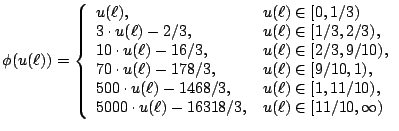
 in Figure 7
that increasingly penalizes loads as they near or pass the link's
capacity. This piecewise-linear function can be expressed by the
equation
in Figure 7
that increasingly penalizes loads as they near or pass the link's
capacity. This piecewise-linear function can be expressed by the
equation
that was introduced in [19] and used in several other
traffic-engineering studies. The network-wide objective function
 is the sum of the link penalties--i.e.,
 .
.
|
[angle=-90,scale=.3]cost-function.eps
|
Network administrators can minimize the objective function by changing
the intradomain paths (
), interdomain routes (), or
the egress-point selection (). Tuning the IGP link weights (to
influence the intradomain paths) and the BGP policies (to influence
the interdomain routes) lead to NP-complete optimization
problems [9,7,8,6]. The
computational intractability of these problems forces the use of
local-search techniques that repeatedly evaluate parameter settings in
the hope of finding a good solution. Although local-search heuristics
often produce good parameter values [9,12], the
solutions are not optimal and are not guaranteed to have performance
that is close to optimal. In addition, the solutions require changing
the IGP weights or BGP policies, which triggers routing-protocol
convergence and leads to transient disruptions. In contrast, using
TIE to control the egress-point selections leads to a simpler
optimization problem that does not require changes to the
routing-protocol configuration. Since we are simply selecting among
existing paths and not change the configuration of routing protocols,
our approach does not trigger routing convergence.

 ,
, 
 ,
,  for
for